Chapter VIII · Religion
Flux and the Covenant
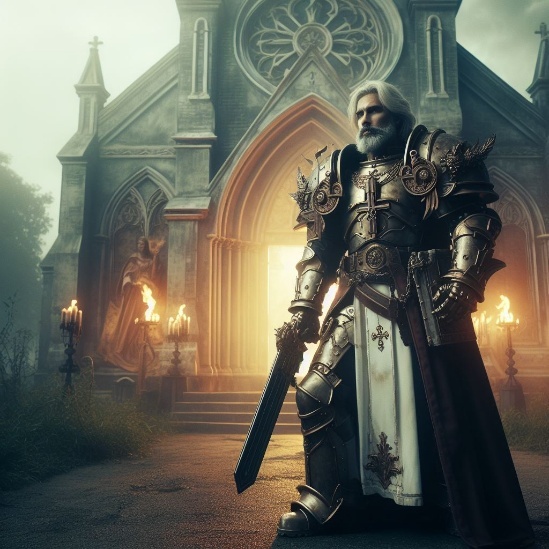
Religion in Eldriloch offers two things: hope, and order. The Celestial Covenant gives people both, and asks only that they believe what they're told about where flux comes from.
Flux
Flux is the power to change the flow of life. Those who use it describe it as a feeling, like controlling a current. They can draw on life force to form shields and bolts of energy, energize their own bodies, and excite cells into healing at unnatural speed, mending in seconds a wound that would take weeks. Flux can move matter but not change it: it can make a shield that deflects an arrow, but it can't turn the arrow into a flower.
Nobody fully understands how flux works. Only humans can use it, and only those with an inborn gift. The Celestial Covenant teaches that flux flows through the gods to their chosen, that hearing a god's voice would turn a mortal body to ash, and that every god forbids using flux to attack. Using it takes focus and drains the user, and a caster who pushes too hard collapses. Healing has limits: flux cannot regrow a lost limb.
The Covenant controls the practice of flux, and its Wardens make sure it stays that way.
The Celestial Covenant
The holy order that oversees the practice of flux. It worships all the gods and tries to bring law and order to the world. Its temples are among the most beautiful buildings in any city, with carved pillars, murals and welcoming steps. It is governed by a select few who use the hope it offers to keep the masses in check. Its faith rests on emotion rather than intellect, and it does not welcome questions. Its priests and healers are votaries. Their spells are listed in Flux Spells.
The Covenant and the Sovereigni
The Celestial Covenant is the only organization in Eldriloch that rivals the power of the Sovereigni. A Sovereigni family commands money, land and law. The Covenant commands belief, which is a more powerful force, and it controls that force tightly: who may preach, which teachings are true, who may use flux, and who is a heretic. Sovereigni have learned the hard way that a family the Covenant turns against loses its Sullied workers, its allies and sometimes its name. A Regnant Sovereigni who defied the Covenant would find the temples preaching against them by morning. So the Sovereigni work with the Covenant, fund its temples and attend its rites, and when it truly matters, they work for it. The Covenant, in turn, blesses their rule and keeps the Sullied hopeful rather than angry. Each side needs the other, and neither forgets it.
The Covenant and the Aether
The Covenant teaches that aetheric manipulation tore the world open in the Dark Sunder, and it discourages the practice in every form. Its priests preach that the web is no place for mortal hands. An aetherian may live and work in Covenant lands, but never with its blessing, and always with a Warden watching.
Engineered equipment is the exception. The Covenant once condemned that too, but the world built itself on machines anyway. Firearms, airships, renderers and every city's mechanoids run on aetheric patterns stored in fibrolite, and a faith that forbade them would have sent its Wardens out against guns with nothing but swords, and its temples would have emptied. So the Covenant drew a line: an engineer's device is a tool, not a sin, as long as the aether stays sealed inside the steel. It accepted this grudgingly, and its Wardens now carry aetheric firearms as a matter of course.
Fleshgrafting is heresy. Setting a machine into a living body puts the aether inside the flesh, and the line the Covenant drew runs exactly there. The Wardens hunt fleshgrafters as heretics, and a person found with grafts can be detained and stripped of them.
Critics call this hypocrisy, and they aren't wrong. The same fibrolite and the same stored patterns drive a Warden's rifle and a fleshgrafter's arm. The difference is that the Covenant can control who makes and sells a gun, and it can't control what a person does to their own body. Few of its leaders believe the doctrine as written. They accepted engineered equipment because refusing it would have cost them their control, and they condemn grafting because allowing it would cost them the same.
Wardens of the Celestial Covenant
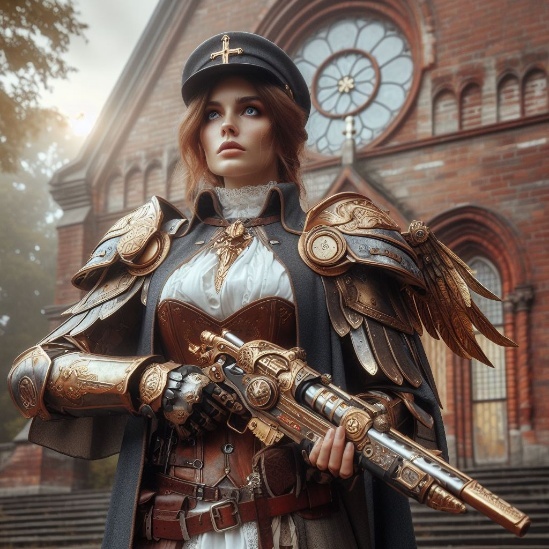
The Wardens of the Celestial Covenant, usually just called Wardens, are the Covenant's enforcers, its "peacekeepers." Their task is to root out heretics who make claims against flux as a practice. Even suggesting that flux can be used without the gods can bring down the wrath of a Warden inquisitor. Wardens hunt ashen as heresy made flesh and fleshgrafters as heretics, and they do it carrying aetheric firearms, a contradiction their enemies never tire of pointing out. They are especially strong in Caerdydd, where they work hand in hand with Gilirak's Peacekeepers. Player characters can be wardens: see the warden class.
Custodians of the Living Light
The spiritual protectors and caretakers of Usmon, working directly under the Wardens. The Custodians run the great monastery at Peltragow, keep the city clean and teach the doctrine of Aostre: protect and nurture, never attack. Their elders sit at the monastery in Peltragow, and they are known for staying out of the Wardens' harsher work.
Rites and Customs
The Rite of Transition. The rite that sends the dead to the gods (see the rite of transition spell). The body is placed in the proper pose, eyes left open so the dead can face the gods with dignity, while the rite's rhythm is hummed. Soldiers are honored by having the rite performed where they fell on the battlefield. Performing it in a town is for family members, and doing so for a soldier is almost a disgrace, as if the sacrifice meant nothing. Any god's temple will serve.
Circle of Truth. A divine working that compels honesty, granted only by gods whose domains include it. Khareus, god of the hunt, does not grant it.
The Soul's Return. Most faiths agree that souls return to a pool after death, lose their memories and are reborn. See What Makes a Soul?
Other Faiths
The Creed of Chaos. The ashen worship no gods. Their creed holds that nothing is fixed, that no order is owed anything, and that every bargain, ruin and rebirth is the world rearranging itself. It has no priests, temples or hymns.
The Living South. The peoples of southern Usmon focus on life and flux and reject all technology.
The Skeptics. Runekar and many aether practitioners trust what they can see in the web over what they're told about the gods. Some wonder aloud whether belief itself limits what flux can do.
For the Game Master the truth about flux
Flux doesn't flow through the gods. It is an energy that has always been there for anyone with the talent to tap. The Covenant wrapped it in the language of the gods because that made it sound spiritual, and made it theirs. Fearing what flux could do, the powerful formed the Wardens of the Celestial Covenant to control it, and scholars and leaders agreed to keep up the story. Notice that all the teachings tying flux to the gods appeared at once, as if every god had revealed itself at the same moment.
A user who believes a god has abandoned them loses access, because belief shapes the connection. One who learns to reach the flow directly, without asking any god, can use it again, including offensively, and the Wardens will kill to keep that from spreading. Some people already wield it at will, ignoring the teachings. Taught this way, flux can even be learned to a small degree by people with talent. How many of the Covenant's own leaders know the truth is left to the Game Master.