Chapter II · Classes
Entertainer
Every eye in the room is on the dancer with the black lace fan. That's the point. While the crowd watches her, her partner lifts a key from the Sovereigni's coat, and by the time the music ends, the man in the corner booth who owed the Registry a debt has stopped breathing. The applause is genuine. It always is.
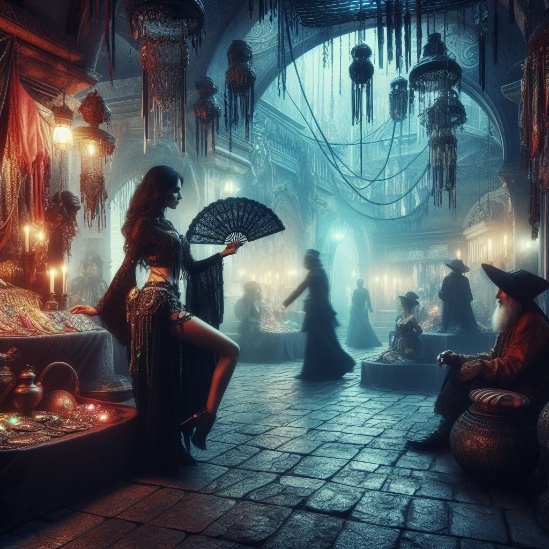
Adventures. Entertainers take jobs: a theft, a message, a disappearance. They travel with circuses, theater companies and gambling airships because a performer is welcome everywhere and questioned nowhere. Many work for the Ebony Eye, Eldriloch's spies and entertainers. The best are invited to carry the Registry's silver coin.
Characteristics. Entertainers replace the bard in Eldriloch, and they don't sing to inspire anyone. An entertainer's performance is a weapon. A Spectacle draws every eye in the room, leaving the audience distracted and off-guard, and the entertainer strikes, steals or slips away while they watch. Entertainers master disguise and poison, strike hard against the unaware, and use a handful of small stage tricks, illusions of light and sound drawn from the aether. They can't use flux, and their performances work on attention, not on minds. There's no magic in a good show, just skill.
Outlook. Few entertainers respect any nation's laws. Those who keep a code follow the Registry's or the Ebony Eye's, and their loyalty goes to whoever pays and whoever protects them.
Religion. Entertainers who pray favor Nylshyra, goddess of night and secrets, or Esriya, whose fickle luck suits a gambler. Most pray only when a job goes wrong.
Background. Entertainers learn in traveling troupes, Veil dens, under-market stages and the back rooms of places like the Whizzing Goat. Many were street children taken in by a troupe that taught them to dance, juggle and pick pockets in the same lesson.
Races. Humans make up most entertainers. Malumtene, who spend their lives in disguise, make chillingly good ones. Shadow souldriven sometimes train as entertainers after release, and audiences rarely guess what's under the coat. Runekar consider the work beneath them, and are therefore never suspected.
Other Classes. Entertainers work best beside runners, who appreciate a distraction, and fighters, who appreciate an enemy that never saw it coming. Wardens make entertainers nervous, since sense the flow sees through a disguise.
Role. The entertainer is a face, an infiltrator and an assassin. In a social scene, they're the most dangerous person in the room. In a fight, they open with a devastating strike against a distracted foe and finish with a skilled blade.
Game Rule Information
Abilities. Charisma powers Perform, Bluff and Disguise, and sets the DC of stage tricks. Dexterity drives stealth and finesse fighting. Intelligence adds skill points and sets the DC of a Final Act.
Hit Die: d6.
Starting Wealth: 4d4 × 10 gl (100 gl).
Class Skills
The entertainer's class skills (and the key ability for each) are Appraise (Int), Balance (Dex), Bluff (Cha), Climb (Str), Craft (Int), Decipher Script (Int), Diplomacy (Cha), Disable Device (Int), Disguise (Cha), Escape Artist (Dex), Forgery (Int), Gather Information (Cha), Hide (Dex), Jump (Str), Listen (Wis), Move Silently (Dex), Open Lock (Dex), Perform (Cha), Profession (Wis), Sense Motive (Wis), Sleight of Hand (Dex), Spot (Wis), Tumble (Dex) and Use Rope (Dex).
Skill Points at 1st Level: (6 + Int modifier) × 4.
Skill Points at Each Additional Level: 6 + Int modifier.
| Level | Base Attack Bonus | Fort | Ref | Will | Special | Stage Tricks |
|---|---|---|---|---|---|---|
| 1st | +0 | +0 | +2 | +2 | Spectacle, trapfinding, stage tricks | Cantrips |
| 2nd | +1 | +0 | +3 | +3 | Unseen blade +1d6, many faces | Cantrips |
| 3rd | +2 | +1 | +3 | +3 | Poison use, crowd cover | Cantrips |
| 4th | +3 | +1 | +4 | +4 | Evasion | I |
| 5th | +3 | +1 | +4 | +4 | Unseen blade +2d6 | I |
| 6th | +4 | +2 | +5 | +5 | Uncanny dodge | I |
| 7th | +5 | +2 | +5 | +5 | Trick of the trade | I |
| 8th | +6/+1 | +2 | +6 | +6 | Unseen blade +3d6 | II |
| 9th | +6/+1 | +3 | +6 | +6 | Quick change | II |
| 10th | +7/+2 | +3 | +7 | +7 | Final act, trick of the trade | II |
| 11th | +8/+3 | +3 | +7 | +7 | Unseen blade +4d6 | II |
| 12th | +9/+4 | +4 | +8 | +8 | Improved uncanny dodge | III |
| 13th | +9/+4 | +4 | +8 | +8 | Trick of the trade | III |
| 14th | +10/+5 | +4 | +9 | +9 | Unseen blade +5d6 | III |
| 15th | +11/+6/+1 | +5 | +9 | +9 | Encore | III |
| 16th | +12/+7/+2 | +5 | +10 | +10 | Trick of the trade | IV |
| 17th | +12/+7/+2 | +5 | +10 | +10 | Unseen blade +6d6 | IV |
| 18th | +13/+8/+3 | +6 | +11 | +11 | — | IV |
| 19th | +14/+9/+4 | +6 | +11 | +11 | Trick of the trade | IV |
| 20th | +15/+10/+5 | +6 | +12 | +12 | Unseen blade +7d6, final curtain | V |
Class Features
All of the following are class features of the entertainer.
Weapon and Armor Proficiency: Entertainers are proficient with all simple weapons, plus the hand crossbow, rapier, sap, short sword, shortbow and whip, and with the pocket pistol (see Firearms). They are proficient with light armor but not with shields.
Spectacle (Ex): An entertainer can turn a performance into a trap. Starting a Spectacle is a standard action: a dance, a song, a juggling act, a card trick, a speech, any Perform skill. Keeping it going is a move action each round. Every creature within 60 feet that can see or hear the performance and isn't already in combat makes a Sense Motive check opposed by the entertainer's Perform check. Those that fail are distracted:
- They take a –4 penalty on Spot, Listen and Sense Motive checks.
- They are denied their Dexterity bonus to AC against the entertainer.
- Anyone stealing from them or hiding from them gets a +4 bonus.
A creature stops being distracted when it's attacked, when it sees someone attacked, or when the Spectacle ends. A Spectacle works on attention, not the mind. It's not mind-affecting and not magical, so it works on souldriven and inside an antimagic field. Mindless creatures ignore it. An entertainer can start a number of Spectacles per day equal to their entertainer level + Charisma modifier.
Trapfinding (Ex): An entertainer can use Search to find traps with a DC higher than 20, and Disable Device to disarm magic traps, as a rogue can.
Stage Tricks (Sp): Entertainers learn a few aetheric tricks of light and sound to dress up a performance, or cover an escape. They can use the cantrips dancing lights, flare, ghost sound and prestidigitation at will. From 4th level, they can also use stage tricks from the tiers on the table below a total number of times per day equal to 3 + their Charisma modifier, choosing any trick from a tier they have reached each time. Caster level equals entertainer level. The save DC is 10 + the trick's spell level + Charisma modifier. Stage tricks are aether only and never draw on flux or fibrolite.
Unseen Blade (Ex): From 2nd level, an entertainer deals extra damage, as rogue sneak attack, when the target is denied its Dexterity bonus to AC or is flanked by the entertainer. The extra damage is +1d6 at 2nd level and increases by 1d6 every three levels after, to +7d6 at 20th. It stacks with sneak attack from other classes.
Many Faces (Ex): At 2nd level, an entertainer adds half their class level as a bonus on Disguise checks, and can create a disguise in 1 minute instead of 1d3 × 10 minutes.
Poison Use (Ex): At 3rd level, an entertainer never risks poisoning themselves when applying poison to a blade.
Crowd Cover (Ex): At 3rd level, an entertainer can Hide in a crowd without cover or concealment, and can move at full speed while hiding among a crowd.
Evasion (Ex): At 4th level, an entertainer takes no damage on a successful Reflex save against an effect that normally deals half damage on a successful save, as a rogue.
Uncanny Dodge (Ex): At 6th level, an entertainer retains their Dexterity bonus to AC when flat-footed or struck by an invisible attacker. At 12th level, they gain improved uncanny dodge and can't be flanked except by a rogue (or entertainer) of at least four higher levels.
Trick of the Trade: At 7th, 10th, 13th, 16th and 19th level, an entertainer chooses one of the following: crippling strike, defensive roll, improved evasion, opportunist, skill mastery, slippery mind (all as the rogue special abilities), or any feat they qualify for.
Quick Change (Ex): At 9th level, an entertainer can change disguises as a full-round action. They can make a Hide check to vanish into a crowd as part of the change.
Final Act (Ex): At 10th level, an entertainer can kill with a performance. If they keep a Spectacle running for 3 consecutive rounds while a distracted creature watches, then attack that creature with an unseen blade, the target must make a Fortitude save (DC 10 + entertainer level + Intelligence modifier) or die. The entertainer can choose to paralyze instead, for 1d6 rounds + 1 round per entertainer level. On a successful save, the attack is still a normal unseen-blade attack. A creature that survives a Final Act can't be targeted by the same entertainer's Final Act for 24 hours.
Encore (Ex): At 15th level, an entertainer can start a Spectacle as a move action and keep it going as a free action.
Final Curtain (Ex): At 20th level, an entertainer's Final Act needs only 1 round of performance, and its save DC increases by 2.
| Tier | Level Reached | Tricks (as the aether spell) |
|---|---|---|
| Cantrips | 1st | dancing lights, flare, ghost sound, prestidigitation (at will) |
| I | 4th | color spray, disguise self, silent image, ventriloquism |
| II | 8th | blur, invisibility, minor image, mirror image, misdirection |
| III | 12th | displacement, invisibility sphere, major image |
| IV | 16th | greater invisibility, hallucinatory terrain, illusory wall |
| V | 20th | false vision, persistent image, seeming |
Playing an Entertainer
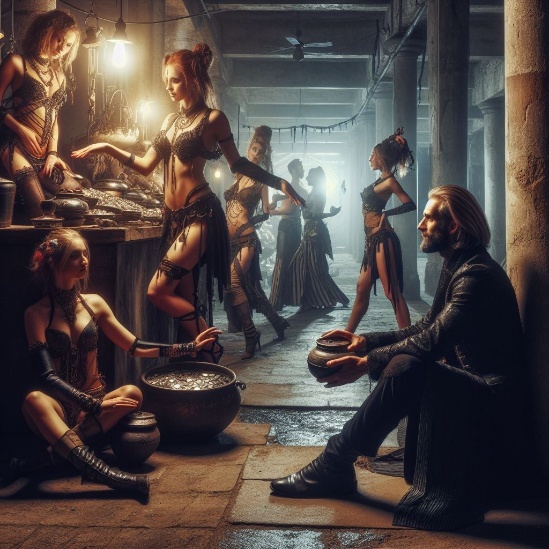
Set the Stage. A Spectacle only works on people who aren't yet fighting. Plan your jobs so you're performing before anyone draws steel: a tavern, a gala, a market square. Then make the first strike count.
The Cover Is the Character. Decide who your entertainer is on stage and who they are off it. A dancer, a fire-eater, a card sharp, a street preacher, an airship's lounge singer: the cover tells you which jobs you'll be hired for.
Know Your Patron. The Ebony Eye, the Veil and the Registry all employ entertainers, and none of them like freelancers. Decide who you work for, or who you're hiding from.
Starting Package: Under-Market Dancer
Race: Human. Ability scores: Str 10, Dex 16, Con 12, Int 13, Wis 10, Cha 15.
Skills: Bluff, Disguise, Hide, Move Silently, Perform (dance), Sense Motive, Sleight of Hand, Tumble. Feats: Weapon Finesse, Persuasive.
Gear: leather armor, rapier, three daggers, black lace fan, two costumes, disguise kit, 15 gl.
Designer's Note: Balance
- Chassis: the 3.5 bard's: d6 Hit Die, medium base attack, good Reflex and Will, 6 + Int skill points.
- No spellcasting: the entertainer gives up the bard's spellcasting and inspire courage entirely.
- Damage: unseen blade reaches +7d6, less than the rogue's +10d6.
- Spectacle: about one guaranteed opening per encounter, if the entertainer sets the scene before the fight. Once combat starts, it does nothing.
- Final Act: the assassin prestige class's death attack, arriving later (10th level rather than about 6th) and needing a Spectacle first.
- Stage tricks: a short list of illusions. The best of them, invisibility and greater invisibility, arrive about four levels later than for an aetherian.
The entertainer sits between the 3.5 rogue and bard: weaker than the rogue at steady damage, stronger at the opening strike and in social scenes, and with far less magic than the bard.