Chapter II · Classes
Fleshgrafter
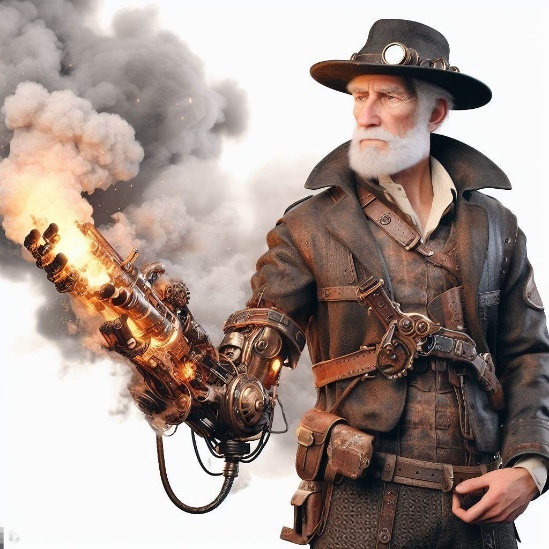
Everyone knows the aether can't touch living flesh. Fleshgrafters know exactly how close it can get. They shape brass and steel right up to the edge of a wound, tie off the threads, and coax the flesh to grow into the metal. The result is an arm that fires, a heart that never tires, or eyes that see through walls, and a surgeon the law would hang if it could find them.

Adventures. Fleshgrafters adventure because staying in one place gets them caught. They follow mercenary companies and criminal crews who need someone to patch them up and make them better than before. Some are hunting rare parts or the notes of a master who died with secrets. Others are simply running from the Wardens.
Characteristics. A fleshgrafter fits graft sockets into willing patients: small ports of brass and fibrolite set into the flesh. Each day, the fleshgrafter primes implants through those sockets, giving each patient one stored spell-like ability: a surge of servo strength, a flechette launcher, a refracting skin that blurs their outline. Fleshgrafters also perform surgery to install permanent grafts, from tool hands and hand cannons to subdermal plating and mechanical hearts. Every implant burns a shard of fibrolite and strains the body that carries it, every graft risks rejection, and every socket is a crime.
Steel, Not Flux. A fleshgrafter's power is aether stored in fibrolite. It never touches flux, so nothing a fleshgrafter does can heal. They can fit flesh to steel, armor it, drive it and push it past its limits, but only flux can mend it, and a wounded patient still needs a healer.
The Forbidden Art. The first forge-grafters needed a flux healer at the table to keep the patient alive, and using aether and flux together was banned after the Dark Sunder. Then the runekar showed that a skilled hand could do it with aether and engineering alone, shaping the metal so precisely that the flesh does the rest. The Covenant calls grafting heresy, the Wardens hunt grafters, and every nation bans it. The same Wardens carry aetheric firearms built from the same fibrolite and patterns, because the Covenant grudgingly accepts engineered equipment as long as it stays out of the body. Only Adryae looks the other way, and even there it is frowned upon. A person with grafts can move about freely if they keep them covered. A fleshgrafter must live in hiding or under the protection of a powerful under-lord.
Outlook. The law calls every fleshgrafter a criminal and the Covenant calls them heretics, so those with scruples follow a personal code. Many are pragmatists who care about the work, not who it's for.
Religion. Few. The Covenant condemns the practice as heresy while blessing the guns its Wardens carry, and fleshgrafters never miss a chance to point out the difference is only where the steel is attached.
Background. Many fleshgrafters began as war surgeons in the War of Souls, where nobody asked how a soldier got a new arm. Others apprenticed to a back-alley master like Olbarl of Murkwell, or were runekar engineers who wondered how far the work could go.
Races. Runekar are the most common fleshgrafters. Aether Sight lets them see exactly where the threads of the metal meet the flesh. Humans are next, and many of the best are former war surgeons. Malumtene grafters are rare and frightening. The exspiratis in an ashen dislike grafts on their host and fight them, so ashen grafters rarely last. Souldriven can never be fleshgrafters, and have no flesh to graft.
Other Classes. Fighters and runners are a fleshgrafter's best customers. Engineers respect the craftsmanship and disapprove of the canvas. Covenant votaries and wardens are sworn to turn them in, and many do.
Role. The fleshgrafter makes the party stronger. Implants hand allies extra spell-like abilities each day, ablative plating soaks damage before it lands, and grafts make allies permanently better. A fleshgrafter is not a healer, and a party with one still needs flux. In a fight, a fleshgrafter is a capable middle-line combatant with a grafted weapon of their own.
Game Rule Information
Abilities. Intelligence determines how many implants a fleshgrafter can prime each day and how hard they are to resist. Constitution matters a great deal: a fleshgrafter usually carries several grafts, and graft load depends on Constitution. Wisdom helps with the Heal skill.
Hit Die: d8.
Starting Wealth: 4d4 × 10 gl (100 gl).
Class Skills
The fleshgrafter's class skills (and the key ability for each) are Appraise (Int), Bluff (Cha), Concentration (Con), Craft (Int), Disable Device (Int), Disguise (Cha), Gather Information (Cha), Heal (Wis), Intimidate (Cha), Knowledge (arcana) (Int), Knowledge (local) (Int), Profession (Wis), Spellcraft (Int) and Use Magic Device (Cha).
Skill Points at 1st Level: (4 + Int modifier) × 4.
Skill Points at Each Additional Level: 4 + Int modifier.
| Level | Base Attack Bonus | Fort | Ref | Will | Special | Implants per Day | |||||
|---|---|---|---|---|---|---|---|---|---|---|---|
| 1st | 2nd | 3rd | 4th | 5th | 6th | ||||||
| 1st | +0 | +2 | +0 | +0 | Implants, fibrolite, graft sockets, field surgeon, salvage, signature graft | 2 | — | — | — | — | — |
| 2nd | +1 | +3 | +0 | +0 | Graft surgery | 3 | — | — | — | — | — |
| 3rd | +2 | +3 | +1 | +1 | Rejection ward | 3 | — | — | — | — | — |
| 4th | +3 | +4 | +1 | +1 | Bonus feat | 3 | 1 | — | — | — | — |
| 5th | +3 | +4 | +1 | +1 | Overclock 1/day, efficient patterns (1st) | 3 | 2 | — | — | — | — |
| 6th | +4 | +5 | +2 | +2 | Quick prime | 3 | 2 | — | — | — | — |
| 7th | +5 | +5 | +2 | +2 | — | 3 | 3 | 1 | — | — | — |
| 8th | +6/+1 | +6 | +2 | +2 | Bonus feat, iron flesh +1 | 3 | 3 | 2 | — | — | — |
| 9th | +6/+1 | +6 | +3 | +3 | Overclock 2/day | 3 | 3 | 2 | — | — | — |
| 10th | +7/+2 | +7 | +3 | +3 | Steady hands, efficient patterns (2nd) | 3 | 3 | 3 | 1 | — | — |
| 11th | +8/+3 | +7 | +3 | +3 | Remote priming | 3 | 3 | 3 | 2 | — | — |
| 12th | +9/+4 | +8 | +4 | +4 | Bonus feat | 3 | 3 | 3 | 2 | — | — |
| 13th | +9/+4 | +8 | +4 | +4 | Overclock 3/day | 3 | 3 | 3 | 3 | 1 | — |
| 14th | +10/+5 | +9 | +4 | +4 | Iron flesh +2 | 4 | 3 | 3 | 3 | 2 | — |
| 15th | +11/+6/+1 | +9 | +5 | +5 | Flesh and steel, efficient patterns (3rd) | 4 | 4 | 3 | 3 | 2 | — |
| 16th | +12/+7/+2 | +10 | +5 | +5 | Bonus feat | 4 | 4 | 4 | 3 | 3 | 1 |
| 17th | +12/+7/+2 | +10 | +5 | +5 | Overclock 4/day | 4 | 4 | 4 | 4 | 3 | 2 |
| 18th | +13/+8/+3 | +11 | +6 | +6 | — | 4 | 4 | 4 | 4 | 4 | 2 |
| 19th | +14/+9/+4 | +11 | +6 | +6 | Perfect graft | 4 | 4 | 4 | 4 | 4 | 3 |
| 20th | +15/+10/+5 | +12 | +6 | +6 | Bonus feat, iron flesh +3, living masterpiece | 4 | 4 | 4 | 4 | 4 | 4 |
Class Features
All of the following are class features of the fleshgrafter.
Weapon and Armor Proficiency: Fleshgrafters are proficient with all simple weapons and with light armor, but not with shields. They are automatically proficient with any weapon built into one of their own grafts.
Graft Sockets (Ex): A fleshgrafter can fit a graft socket, a small port of brass and fibrolite, into a willing or helpless creature. Fitting one takes 1 hour, 50 gl of materials and a DC 15 Heal check. A failed check wastes the materials and deals 1d4 points of damage to the patient. A creature can have only one socket, and sockets don't count against graft load. Constructs, undead and creatures without flesh can't take sockets. A fleshgrafter starts play with a socket of their own. Sockets are visible. Covering one with clothing is easy, but anyone who finds it knows exactly what it is.
Implants: A fleshgrafter's main power is the implant: a stored spell-like ability primed into a creature through its socket. Implants are drawn from the fleshgrafter implant list below. Each day, a fleshgrafter can prime the number of implants of each level given on Table: The Fleshgrafter, plus bonus implants for a high Intelligence score, using the bonus spells table in the Player's Handbook. To prime an implant of a given level, a fleshgrafter must have an Intelligence score of at least 10 + the implant's level. Every implant by level, with a link to each effect's description, is in Spells by Class.
Priming an implant takes 1 minute of work on a creature with a socket, which can be the fleshgrafter. An implant stays primed for 24 hours or until it is used. A creature can hold primed implants whose levels add up to no more than its Hit Dice. A 3rd-level fighter, for example, can hold three 1st-level implants or one 1st-level and one 2nd-level implant.
Activating an implant is a spell-like ability for the host, using the action the spell normally takes. The caster level equals the fleshgrafter's class level, and the save DC, if any, is 10 + the implant's level + the fleshgrafter's Intelligence modifier. An implant whose spell has a range of personal or touch affects only its host. Other implants work as the spell, originating from the host. Implants are aetheric and are subject to dispel magic and spell resistance like spells. Every activation strains the host (see Strain and Malfunction).
Fibrolite (Ex): A fleshgrafter can't work the aether directly as an aetherian does, and never draws on flux. Every implant needs a fibrolite shard sized to its level, set into the host's socket when it is primed (see Fibrolite Shards): 2 gl for a 1st-level implant, rising to 72 gl for a 6th-level implant. The shard is used up when the implant is activated. An implant that goes unused gives its shard back to be set again the next day.
Salvage (Ex): A fleshgrafter recovers fibrolite from a destroyed construct or aetheric device in 1 minute instead of 10, and adds their Field Surgeon bonus on the check. On a failed check, they still recover half the value.
Signature Graft (Ex): At 1st level, a fleshgrafter has already grafted themselves: a blade arm or a hand cannon (see Grafts), installed without a rejection save. It doesn't count against their graft load. Every fleshgrafter tests the work on themselves first.
Efficient Patterns (Ex): At 5th level, a fleshgrafter's 1st-level implants need no fibrolite. At 10th level, 2nd-level implants need none either, and at 15th level, 3rd-level implants need none. Higher-level implants always need their shards.
Field Surgeon (Ex): A fleshgrafter adds half their class level (minimum 1) as a bonus on Heal checks and on Craft (engineering) checks made to build grafts.
Graft Surgery (Ex): At 2nd level, a fleshgrafter can build and install permanent grafts (see Grafts below). Building a graft works like crafting a wondrous item, using the fleshgrafter's class level as caster level, but needs no feat. It costs half the market price in materials and 1/25 of the market price in XP. With the Game Master's approval, a fleshgrafter can also build any wondrous item that affects its wearer as a graft that takes up the same slot. Installing a graft takes 8 hours of surgery and a DC 15 Heal check, after which the patient must resist rejection.
Rejection Ward (Ex): At 3rd level, patients, including the fleshgrafter, gain a +4 bonus on rejection saves for grafts the fleshgrafter installs (see Grafts), and a +2 bonus on strain saves for implants the fleshgrafter primes. The strain bonus increases to +4 at 11th level.
Bonus Feats: At 4th, 8th, 12th, 16th and 20th level, a fleshgrafter gains a bonus feat chosen from this list: Craft Magic Arms and Armor, Fail-Safe, Tempered Fittings, Craft Wondrous Item, Diehard, Endurance, Exotic Weapon Proficiency (firearms), Great Fortitude, Improved Initiative, Point Blank Shot, Self-Sufficient, Skill Focus (Heal), Toughness, Weapon Focus (any grafted weapon).
Overclock (Su): Starting at 5th level, once per day, when a host within 30 feet activates an implant the fleshgrafter primed, the fleshgrafter can overclock it as an immediate action. The implant's caster level increases by 2 and its save DC by 1, but the host's strain save DC increases by 2 as the graft runs hot. They can do this one additional time per day at 9th, 13th and 17th level.
Quick Prime (Ex): At 6th level, a fleshgrafter can prime an implant as a full-round action instead of 1 minute.
Iron Flesh (Ex): At 8th level, a fleshgrafter's own body is laced with metal, giving a +1 natural armor bonus. This stacks with enhancement bonuses to natural armor, including subdermal plating. It increases to +2 at 14th level and +3 at 20th level.
Steady Hands (Ex): At 10th level, a fleshgrafter can take 10 on Heal and Craft (engineering) checks even when rushed or threatened, and can install a graft in 1 hour instead of 8.
Remote Priming (Su): At 11th level, a fleshgrafter can prime an implant into a host within 30 feet as a standard action, reaching the socket through the aether.
Flesh and Steel (Ex): At 15th level, the fleshgrafter's own graft load increases by 2. Patients the fleshgrafter installs grafts in gain +1 graft load.
Perfect Graft (Ex): At 19th level, grafts the fleshgrafter installs are never rejected, and hosts automatically succeed on strain saves for 1st- through 3rd-level implants the fleshgrafter primes.
Living Masterpiece (Su): At 20th level, once per day, when a host activates an implant the fleshgrafter primed, the implant stays primed and can be used again.
Fleshgrafter Implant List
Each implant produces the effect of the spell named in parentheses. It is the graft doing the work: servos driving muscle, lenses refracting light, plates sliding out over the skin. No implant heals. Temporary hit points from ablative plating are armor taking the blow, and they don't stack with each other.
| Level | Implants |
|---|---|
| 1st | Adrenal pump (expeditious retreat), spring tendons (jump), gyro stabilizer (feather fall), deploying plates (shield), plating mesh (aether plating), targeting lens (true strike), flechette launcher (magic missile), ablative plating (host gains 1d10 temporary hit points + 1 per caster level, maximum +5, for 1 hour), thermal regulator (endure elements), blade tuning (magic weapon, grafted or held weapon) |
| 2nd | Servo surge (iron strength), reflex surge (quickened reflexes), heart surge (iron endurance), night lens (darkvision), grip hooks (grip climb), arc emitter (scorching ray), refractor plates (blur), aether lens (see invisibility), heat sink (resist energy), ablative plating II (2d10 temporary hit points + 1 per caster level, maximum +10, for 1 hour) |
| 3rd | Overclocked servos (haste, host only), arc cannon (lightning bolt), wing pistons (fly), aether lung (water breathing), plating weave (protection from energy), refractor array (displacement), blade overhaul (greater magic weapon), honed edge (keen edge, grafted or held weapon) |
| 4th | Stone plating (stoneskin), joint lubricant (freedom of movement), heat exchanger (fire shield), cloaking lattice (greater invisibility), frost vent (ice storm), resonator (shout), ablative plating III (4d10 temporary hit points + 1 per caster level, maximum +20, for 1 hour) |
| 5th | Frost cannon (cone of cold), long-range thrusters (overland flight), aether damper (spell resistance), lifting arm (telekinesis, host's own arm) |
| 6th | War engine (Combat Overdrive), chain arc (chain lightning), true lens (true seeing), unmaker gauntlet (disintegrate) |
Strain and Malfunction
Flesh was never meant to carry machinery, and every implant activation pushes it a little further. Right after a host activates an implant, the effect takes place, and then the host makes a strain save: a Fortitude save against DC 5 + the implant's level + the number of implants the host has already activated since their last 8 hours of rest. An overclocked implant adds +2 to the DC.
A natural 20 always succeeds. A natural 1 always fails and adds +2 to the malfunction roll. On a failure, the host rolls 1d12 + the implant's level on the Malfunction table. The fleshgrafter's own implants follow the same rules.
Hosts who keep using implants get worse odds as the day goes on. A wise fleshgrafter spreads implants across the party rather than loading one host.
| 1d12 + Level | Result |
|---|---|
| 2–4 | Sparks. The socket arcs. The host takes 1d6 points of electricity damage. |
| 5–6 | Seized Joint. A servo locks. The host takes a –2 penalty on attack rolls and to AC for 1d4 rounds. |
| 7–8 | Lens Flare. Light floods the host's optic lines. The host is blinded for 1 round and dazzled for 1 minute. |
| 9–10 | Feedback. The host takes 2d6 points of electricity damage and is dazed for 1 round. |
| 11–12 | Burnout. The socket burns out. All other implants primed in the host are lost (their shards with them), and the socket holds nothing until repaired (1 hour and a DC 15 Heal check). |
| 13–14 | Shutdown. Every graft the host carries stops working for 1d4 rounds, and the host is stunned for 1 round. |
| 15–16 | Overload. The graft overheats. The host takes 1d6 points of fire damage per implant level (Reflex half) and 1 point of Constitution damage. |
| 17+ | Rejection Spasm. The host's body turns on its machinery. One random graft is rejected as if the host had failed its rejection save (1d4 Con damage, and the graft stops working until reinstalled). A host with no grafts takes 1d4 points of Constitution damage, and its socket burns out. |
Fleshgrafter Feats
Fail-Safe
Prerequisite: Fleshgrafter level 4th.
Benefit: Once per day, when a host within 30 feet fails a strain save for an implant you primed, you can let them reroll the save as an immediate action. They must take the second result.
Tempered Fittings
Prerequisite: Fleshgrafter level 3rd.
Benefit: Subtract 2 from every roll on the Malfunction table for implants you prime (minimum 2). Your sockets are cut cleaner and seated deeper.
Grafts
A graft is a permanent piece of engineering set into living flesh. Grafts are magic items that take up a body slot, and a creature can't wear a magic item in a slot a graft fills. They can't be removed without surgery, stolen or disarmed, and they keep working while their host sleeps.
Graft Load: A creature can carry a number of grafts equal to 1 + its Constitution modifier (minimum 1). Sockets don't count. If the creature's Constitution later drops below the requirement, its newest graft stops working until its Constitution recovers.
Rejection: When a graft is installed, the patient makes a Fortitude save against the graft's rejection DC. On a success, the graft takes and never needs another save. On a failure, the body rejects it: the patient takes 1d4 points of Constitution damage, and the graft must be removed. It can be installed again after a week. Rejection saves can't be retried by taking 10 or 20.
Law and Disguise: Grafts are illegal almost everywhere. Hiding a visible graft takes a Disguise check opposed by observers' Spot checks. The Wardens and the Peacekeepers both train people to look for them.
Sovereigni Patients: No Sovereigni will admit to a graft. They see needing one as weakness, and a discovered graft can ruin a family. The few who are grafted pay a fleshgrafter extremely well for discreet work, concealed placement and silence, and expect it to last. A fleshgrafter with a Sovereigni client has a fortune and a death sentence in the same ledger.
| Graft | Slot | Effect | Rejection DC | Market Price |
|---|---|---|---|---|
| Tool hand | Hands | Masterwork tools built into the fingers. +2 on Craft (engineering), Disable Device and Open Lock checks. | 10 | 300 gl |
| Blade arm | Arms | A retractable masterwork short sword or longsword. Deploy or retract it as a free action. Can't be disarmed, and can be enchanted as a weapon. | 10 | 1,000 gl |
| Hand cannon | Arms | A built-in firearm (1d10, ×3, 50 ft, 4 rounds). Can't be disarmed. Reloading is a full-round action. Can be enchanted as a weapon. | 11 | 2,500 gl |
| Grip hooks | Hands | Retractable climbing hooks. +5 competence bonus on Climb checks. | 11 | 2,500 gl |
| Telescopic eye | Eyes | +5 competence bonus on Spot checks. | 11 | 2,500 gl |
| Ear horn | Head | +5 competence bonus on Listen checks. | 11 | 2,500 gl |
| Subdermal plating | Neck | +1, +2 or +3 enhancement bonus to natural armor. | 11 / 14 / 19 | 2,000 / 8,000 / 18,000 gl |
| Servo arms | Arms | +2 or +4 enhancement bonus to Strength. | 12 / 18 | 4,000 / 16,000 gl |
| Reflex wiring | Shoulders | +2 or +4 enhancement bonus to Dexterity. | 12 / 18 | 4,000 / 16,000 gl |
| Mechanical heart | Torso | +2 or +4 enhancement bonus to Constitution. Counts toward its own graft load requirement only after it takes. | 12 / 18 | 4,000 / 16,000 gl |
| Piston legs | Feet | +10 ft enhancement bonus to land speed and +5 competence bonus on Jump checks. | 12 | 5,500 gl |
| Aether lung | Throat | Breathe normally in any air, and immune to inhaled poisons and gases, as a necklace of adaptation. | 14 | 9,000 gl |
| Night eye | Eyes | Darkvision 60 ft. | 16 | 12,000 gl |
Rejection DC is 10 + 1 per 2,000 gl of market price (rounded down, maximum 20). A grafted weapon can be enchanted with Craft Magic Arms and Armor. Its enhancement adds to its price but not to its rejection DC.
Playing a Fleshgrafter
Socket the Party. Your implants only work in sockets, so a fleshgrafter with no patients is a fleshgrafter with half a class. Talk with the other players about who will take a socket, and what that means for their characters when a Warden is watching.
Fit the Implant to the Host. A servo surge belongs in the fighter, a refractor array in the runner, and ablative plating in whoever is about to stand in front. Prime in the morning, but hold back a slot or two for the fight you didn't see coming. Quick Prime and Remote Priming make that easier later.
Grafts Are Gear. Grafts cost what magic items cost. A fleshgrafter saves the party money the way any crafter does, but doesn't make the party richer. The real price is rejection, graft load and the law.
Roleplaying. Decide where you learned. Decide who protects you, and what they ask in return. Decide what you'll refuse to put in a body, if anything.
Starting Package: Back-Alley Grafter
Race: Runekar. Ability scores: Str 8, Dex 13, Con 14, Int 16, Wis 12, Cha 10.
Skills: Craft (engineering), Disguise, Heal, Knowledge (arcana), Knowledge (local), Spellcraft. Feat: Toughness.
Signature graft: hand cannon. Implants primed: ablative plating, plating mesh, flechette launcher (bonus implant from Intelligence). Gear: studded leather armor, Small light crossbow and 20 bolts, 10 rounds for the hand cannon, healer's kit, tool kit, graft socket (own), 12 fibrolite chips (1st-level, 24 gl), 6 gl.
Designer's Note: Balance
The fleshgrafter is built to sit in the same band as the 3.5 bard, the engineer and the 3.5 artificer. It went through one rebalance: removing all healing, adding the fibrolite cost and adding the Malfunction table each made it weaker, and the signature graft, ablative plating and the strain mitigations give some of that back.
- Chassis: d8 Hit Die, medium base attack, one good save (Fortitude), 4 + Int skill points, light armor only. The d8 pays for the lack of medium armor and shields.
- Implants: same slot curve as the engineer's devices, reaching 3rd-level effects at 7th level and 6th-level effects at 16th, like a bard. They have limits devices don't: a host needs a socket, a host can hold only as many implant levels as its Hit Dice, priming takes a minute until 6th level, and most implants affect only their host. They do let allies act with their own actions, which is the class's real power.
- No healing: without flux, the fleshgrafter can't heal at all. Ablative plating (temporary hit points at 1st, 2nd and 4th level) is the replacement. It prevents damage rather than restoring it, it must be primed in advance, and it doesn't stack. That's a clear step down from a 3.5 bard's cure spells, and it's why the class lost its claim to being a backup healer.
- Strain: the first implant a host uses each day fails its strain save rarely. A 1st-level fighter with Fortitude +4 against DC 6 fails only on a 1, and Rejection Ward adds +2 from 3rd level. A host using its third or fourth implant in a day, or an overclocked one, fails often. Most malfunctions cost a round or a few hit points. The rare bad results (rolls of 15 or higher) need high-level implants or bad luck. In practice, strain limits how many implants one host can use, not how many the fleshgrafter can prime.
- Fibrolite: the same cost as the engineer's. With Efficient Patterns, a full day's implants run about 2% of expected wealth over ten adventuring days, and the Game Master can make supply scarce.
- Signature graft: a free blade arm (1,000 gl) or hand cannon (2,500 gl) at 1st level is generous early. But it's a masterwork weapon at best, it can't be swapped for anything else, and by 3rd level its value is small next to normal wealth. It gives the fleshgrafter a reliable weapon to make up for losing healing.
- Grafts: every graft uses Dungeon Master's Guide item prices and takes a body slot, so grafts add no power beyond normal wealth by level. The fleshgrafter's edge is crafting at half price, like any crafter with an item creation feat.
With all of this, the fleshgrafter is a buffer and skirmisher. It's a little weaker than a bard in raw support and a little better in a fight. It falls behind if the party won't take sockets or the campaign has no fibrolite, and it pulls ahead in a party that leans on its implants and a campaign full of constructs to salvage.