Chapter VII · Technology
Aether and Autonomation
Eldriloch runs on a crystal that shouldn't exist, mined from a wound that shouldn't be open, with the help of beings who want to destroy it. Every diesel carriage, floating train and sweeping mechanoid depends on fibrolite and on the aether woven into it.
The Aether
The aether is a dimension that binds reality together. Its components are tied together like a complex web of shining threads that meet at connection points. A practitioner who learns to shift their mind into the aether can unhook a thread from one point and attach it to another, and the matter around it changes: wood grows tendrils, stone erupts from the ground, steel liquefies, light bends into an illusion.
The aether alters non-biological objects. It can turn a marble into a diamond, but it cannot cure a sickness, because living tissue is moved by a life force it cannot touch. Viewed properly, the web can even be used to predict outcomes.
The web always pushes back, trying to return to its natural form, so keeping a change in place is one of the hardest parts of the art. Working with existing material helps. A weaving can be learned, but it is difficult, and only the best practitioners can make the web do exactly what they want. The risk of pulling the wrong threads, and the memory of the Dark Sunder, are why aetheric manipulation is so widely mistrusted. Most nations restrict it, and Usmon forbids it outside the Council of Arcanum.
Fibrolite
[fi-brō-līt]
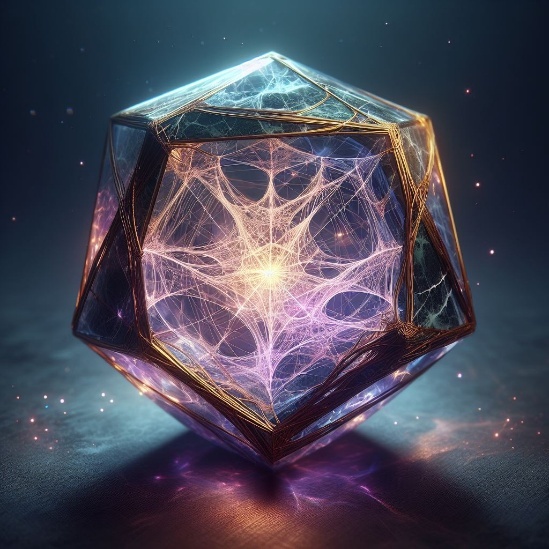
Fibrolite is a rare material that stores aetheric patterns, preserving a logical procedure. It drives the logic of every machine, including mechanoids. A fragment roughly the size of a fist can hold a souldriven's soul. Mechanoids, vehicles and defensive turrets need only a chip about the size of a small four-sided die.
Fibrolite formed when the two realities blended in the Dark Sunder, and it is mined in the Fiend's Chasm, where only the ashen can work. It is extremely rare and valuable, hard to obtain, and commonly sold on the underground market. The demand is so great that bold scavengers capture souldriven and harvest the fibrolite from their bodies.
Glim
Not every stone that leaves the Chasm is whole. Fibrolite cracked in the mining or the cutting can never hold an aetheric pattern, and engineers can't use it. It still glows faintly, though, it can only come from the Chasm, and there's never enough of it, so cracked fibrolite became the money that crosses every border. It's called glim, and it's the standard currency of these rules (see Money). Ethon, which controls the Chasm, uses nothing else.
Fibrolite Shards
Aetherians work the aether web directly and need nothing but skill. Engineers and fleshgrafters can't. They store the aether in fibrolite, and every device or implant they make needs a shard to hold its pattern. The more powerful the effect, the bigger the shard. Neither class ever draws on flux: what fibrolite holds is aether, so it can move, shape, burn and shield, but it can never heal.
| Effect Level | Shard | Cost |
|---|---|---|
| 1st | Chip the size of a grain of rice | 2 gl |
| 2nd | Chip the size of a pea | 8 gl |
| 3rd | Shard the size of a small die | 18 gl |
| 4th | Shard the size of a thumbnail | 32 gl |
| 5th | Shard the size of a thumb | 50 gl |
| 6th | Crystal the size of a walnut | 72 gl |
Using Shards. A shard is set into a device when it is readied, or into a host's socket when an implant is primed. It is used up when the effect is triggered. A shard whose device or implant goes unused can be recovered and set again the next day. Shards of a given size are interchangeable, and a larger shard can stand in for a smaller one.
Supply. The listed prices hold in cities with steady trade, such as Adryae's cities and Caerdydd. Elsewhere, shards come from the under-market at whatever price the seller names, and the Game Master may limit how many are for sale. Fibrolite is also a common reward: a destroyed mechanoid, nib or souldriven still holds its core.
| Source | Shards Recovered (value) |
|---|---|
| Tiny or Small mechanoid | 25 gl |
| Medium mechanoid or sentry turret | 50 gl |
| Large mechanoid or war machine | 150 gl |
| Nib guardian | 200 gl |
| Souldriven | 400 gl (and a moral question) |
Recovering fibrolite takes 10 minutes and a DC 15 Craft (engineering) check. A failed check shatters half the value. The Salvage class feature makes this easier for engineers and fleshgrafters.
Autonomation
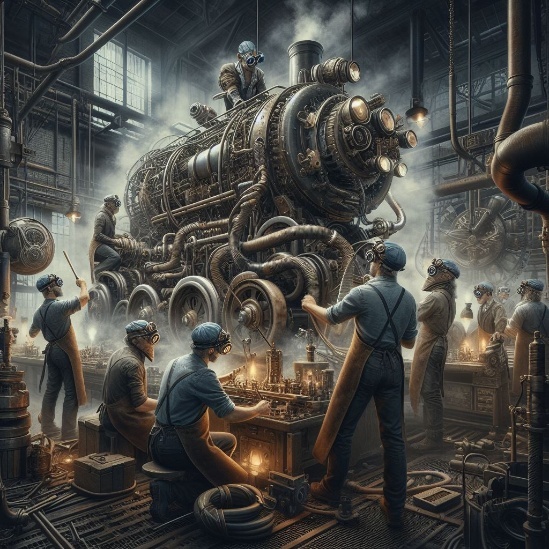
Autonomation is the union of aether and engineering. Using fibrolite, engineers have learned to capture an aetheric weaving and store it inside a physical object. The result is vehicles, mechanoids and other machines that work with the aether to perform daily tasks or move themselves. Glowing orbs serve as controls and lights, and horseless carriages and mechanical horses travel the roads.
Mechanoids follow simple stored instructions. Souldriven go much further and can think and adapt. Both are described in Other Beings and Souldriven.
The Runekar Rail
After the Dark Sunder, the runekar built a railway connecting every major city on the continent as their final apology for their mistake. Many died building it. Its trains have no wheels. They float about a foot above a sturdy metal rod, balanced by powerful aetheric manipulation and steered by a glowing control orb that the operator spins forward or back. Smaller platforms called draisines ride the same rod, and transfer stations serve as off-ramps for cargo.
A Gift for Everyone. The runekar meant the rail to be free. Anyone, of any race or nation, was to ride it anywhere without paying a fare or showing a paper, and the runekar believed that people who could travel freely among one another would stop fearing one another. The rail was their attempt to unify a continent the Sunder had broken. It didn't last. Within a generation, the nations had claimed the stations on their land, the Sovereigni bought the routes, and fares appeared: cheap standing cars for the Sullied, upholstered cars for those who could pay, and papers checked at every border station. Today the rail serves first those who control it. Its trains carry troops, ore and fibrolite before they carry anyone else, and in Staerhiel the Peacekeepers decide who boards at all. Many runekar consider the rail their second great failure, after the Sunder itself.
The runekar built the largest aetheric containment system in the world without fibrolite, and they refuse to teach anyone how, fearing it would be turned into weapons. When the War of Souls turned trains into troop carriers and Ethon tore up the track through the Dryarwood Forest, between Sherfield and Ashborne, the runekar swore off any more work on it. The rail now runs in two halves, Usmon and Adryae in the west and Ethon and Staerhiel in the east and south, with nothing joining them. The system has been decaying ever since, and one day the nations may have only airships and carts.
Airships
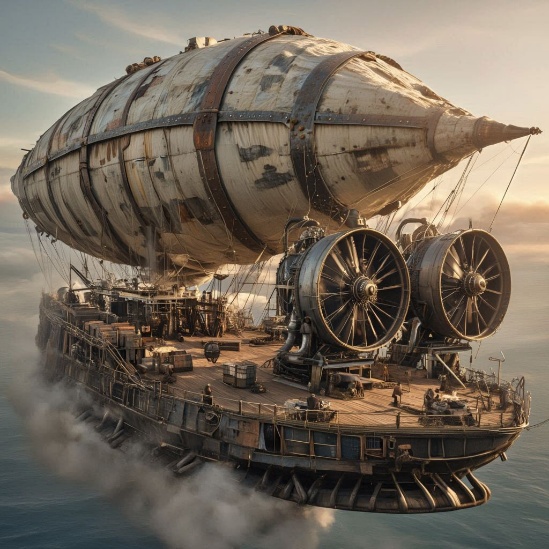
Adryae invented the airship during the War of Souls to carry alloys from Staerhiel. Cargo ships the size of small towns were soon built, and later ships that never touched the ground at all and needed special docks. They carried more, but their flight paths became predictable.
With so much wealth in the air, privateers quickly turned the technology into fast, powerful ships designed to intercept trade. Valuable cargo now travels with fighter escorts, and daring privateers still try their luck. The Veil will help plan an attempt for the right price. Small private ships like the Cloudcutter ferry the wealthy, with a leather-and-steel balloon above, turbines behind and signal lamps to announce their intentions in crowded skies. Usmon bans airships entirely.
Renderers
A renderer is a smooth stone used to communicate over long distances. The user focuses on it and their consciousness slips inside, a dizzying, seasick sensation, where they meet a hazy image of the person holding the linked renderer. The recipient feels a strong pull to answer. Renderers can be set into circlets, and they are perfect for secret communication across any distance, but they are expensive. Couriers are now needed mostly to deliver renderers. Monastery students are taught to use them as children, and nobody warns them about the nausea.
Firearms
Tinkers have made firearms, but they are rare and the ammunition is rarer still. Each round is packed with a small piece of fibrolite, so a shot can carry an aetheric effect, such as bursting into burning fragments inside its target. Souldriven built for pursuit may carry a revolver in a hidden compartment in the leg. The Celestial Covenant discourages aetheric manipulation but grudgingly accepts engineered equipment, and its Wardens are among the best-armed people on the continent.
Firearm, ammunition and artillery rules are in Firearms and Artillery. The engineer class builds them.
Flesh-Grafting
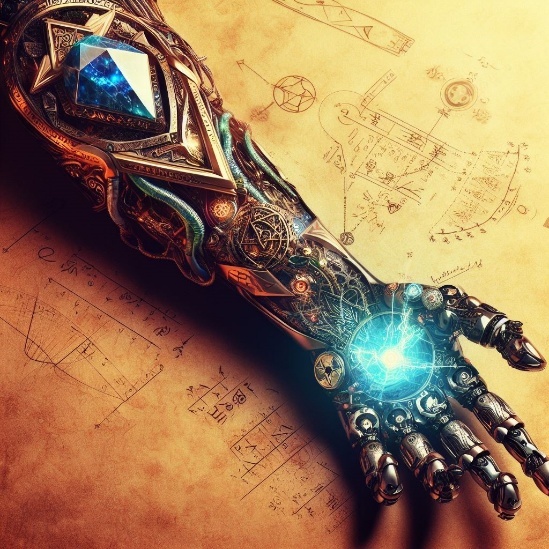
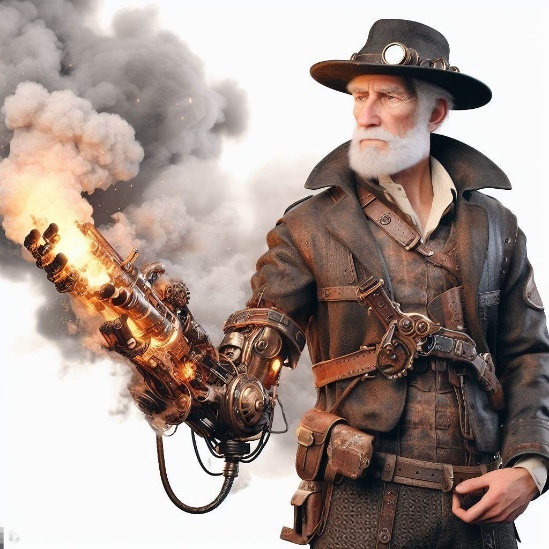
Flesh-grafting (also called forge-grafting) is a controversial, high-risk way of joining technology to the body. Successful examples include an arm replaced with a hand cannon, legs that jump higher, and eyes that see farther. The first grafters needed flux, the aetheric arts and engineering together, and using the two magics together was banned after the Dark Sunder. Then runekar grafters showed it could be done with aether and engineering alone, by shaping metal so precisely that the flesh grows into it. Either way, the body often rejects the part, which can mean death or worse. The Celestial Covenant calls it heresy, even though it accepts the same aetheric engineering in a Warden's rifle (see The Covenant and the Aether).
A grafter fuses metal to flesh with an aetheric flame. The flesh sends out filaments that bond to the metal, and a chip of fibrolite brings the limb to life. A new limb is often stronger and faster than the original, but there's no telling what the grafter can find on the market, and it may never feel like a real arm. A person with forge-grafted parts can move about freely, but a forge-grafter must live in hiding or under the protection of a powerful under-lord.
Rules for grafts, rejection and graft load are in the fleshgrafter class.